Retiring With Rental Properties: Using a “Real Estate Meltdown” to Fund Retiremen

As an MDJ reader you’ve probably heard us talk about the RRSP meltdown strategy. What thousands of mom-and-pop landlords need however, is a real estate meltdown guide. If you’re retiring with large illiquid assets like rental properties, proper planning will save you hundreds of thousands of dollars in taxes over the length of your retirement (and likely mean a much larger estate gets passed along).
Quick Aside: The RRSP meltdown is not a financial emergency. It is an intentionally boring retirement tax strategy. Instead of waiting until age 71 to convert a large RRSP into a RRIF, a retiree gradually withdraws money during lower-income years. The general idea is to pay some tax earlier, at a lower rate, while creating money to live on before CPP, OAS and mandatory RRIF withdrawals all begin showing up on the same tax return. Ideally the plan allows you to smooth out your taxable income each year, so that it all gets taxed in lower income tax brackets.
I’m using the term real estate meltdown to refer to deliberately selling one or more rental properties over several years and converting the after-tax proceeds into spendable retirement capital. The same early-retirement window that can make an RRSP meltdown strategy useful is often the same time that selling rental properties can make a lot of sense.
Rental properties have been outstanding investments for many Canadians over the last couple of decades. In a perfect world, your rental property can generate fairly predictable income, and you can raise rents over time in high-inflation environments. My pick for best financial planner in Canada, Jason Heath, has even went so far as to compare those characteristics to an indexed pension. However, there are some pretty clear negative tradeoffs to basically running your own small business (which is what owning 1-5 rental properties is really) as you enter your Golden Years.
When I have helped people make their decision on whether or not to meltdown their rental properties, I tend to come back to the following considerations:
- Could your capital earn better returns elsewhere?
- Are you at risk due to a non-diversified nest egg?
- Do you still want to run a small business?
- Is holding on to the properties tax efficient for your own spending or your estate?
It usually boils down to some variation of those main concerns.
The Paid-Off Rental Property Paradox
Paying off a rental-property mortgage feels like crossing the finish line. The monthly payment is gone, cash flow improves, and rising interest rates can no longer blow up the budget at renewal time. Those are real benefits. A mortgage-free rental is safer and easier to carry than a highly-leveraged one.
However, the sad math is that a paid-off rental property also ends the leverage that may have produced much of the property’s eye-catching historical return.
Suppose an investor bought a $300,000 rental with a $60,000 down payment. A $30,000 increase in the property value would represent a 10% gain on the property, but it would equal 50% of the original down payment before interest, expenses and transaction costs. That is the magic and danger of leverage. It makes a good outcome look very good. (It can also make a bad outcome look very bad.) It’s also really the only reason that real estate returns are even close to the returns of the stock market for many investors.
Now fast-forward 25 years. The mortgage is gone and the property is worth $800,000. The landlord no longer has $60,000 invested in the property. They have $800,000 of equity tied up in one unleveraged asset. The original purchase price might be relevant when calculating the eventual capital gain, but it is no longer the right number for judging the property’s current investment return.
Suppose an investor bought a $300,000 rental with a $60,000 down payment. A $30,000 increase in the property value would represent a 10% gain on the property, but it would equal 50% of the original down payment before interest, expenses and transaction costs. That is the magic and danger of leverage. It makes a good outcome look very good. (It can also make a bad outcome look very bad.) It’s also really the only reason that real estate returns are even close to the returns of the stock market for many investors.
Now fast-forward 25 years. The mortgage is gone and the property is worth $800,000. The landlord no longer has $60,000 invested in the property. They have $800,000 of equity tied up in one unleveraged asset. The original purchase price might be relevant when calculating the eventual capital gain, but it is no longer the right number for judging the property’s current investment return.
The basic calculation is:
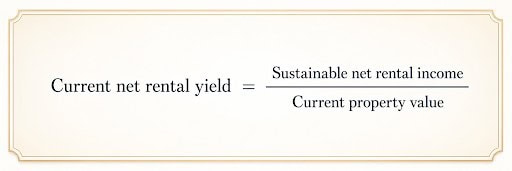
Imagine that the $800,000 property produces $24,000 a year after property tax, insurance and routine expenses, but before setting aside enough for vacancies and major replacements. At first glance, $24,000 of mortgage-free income sounds pretty good. Divided by the property’s current value, however, it is only a 3% yield.
If a realistic allowance for vacancies, a future roof, appliances and other major costs reduces sustainable income to $20,000, the yield falls to 2.5%.
That is before personal income tax (and you can’t hide this income in a registered account in order to defer it). It also assumes the landlord’s time is worth nothing, which is a bold assumption to make about your own retirement.
I would include a market-rate property-management cost in this calculation even if the owner still manages everything personally. Otherwise, we are combining two different returns: the return produced by the property AND the wages the owner earns by doing the manager’s job for free. That distinction becomes much more important when the owner is trying to decide whether they still want the job in retirement.
A proper estimate of sustainable rental income should account for:
- Property tax and insurance
- Routine repairs and maintenance
- Vacancy and unpaid rent
- Major replacements, including roofs, furnaces and appliances
- Condo fees and any utilities paid by the owner
- Legal, accounting and administrative costs
- A realistic cost for property management
This does not prove that the rental is a bad investment. The owner may expect rents to rise and the property may continue appreciating.
What If We Sold + Invested the Cash?
We need to use the current market value when measuring the return on the equity presently tied up in the property. If you are considering a sale, use the after-tax sale proceeds when estimating what a diversified portfolio could provide. Comparing the property’s $20,000 of net income with a hypothetical portfolio built from the full $800,000 would be misleading because realtor fees, legal costs, capital-gains tax and possible CCA recapture could leave substantially less capital available to invest.
Take our hypothetical $800,000 paid-off rental producing $20,000 of sustainable annual income. That property currently has a net rental yield of just 2.5%. That’s the number I care about when deciding whether $800,000 of equity should remain invested in the property. But if we actually sell it, we obviously don’t get to invest the entire $800,000. Realtor commissions, legal costs, capital gains tax, and potentially CCA recapture could leave us with substantially less. If the final after-tax amount is $650,000, then $650,000 is what we should compare with the rental.
Another mistake I see is comparing the $20,000 of rent with whatever dividends or capital gains a portfolio might produce. That isn’t apples-to-apples either. The total return from a rental consists of net rental income plus property appreciation. A stock-and-bond portfolio earns its total return through interest, dividends and capital appreciation. Comparing rent with dividends ignores a huge part of the potential stock-market return. It also ignores the fact that most Canadians still have a substantial amount of room to take that $650,000 and invest within their RRSP and TFSA. Even if they don’t have room in their registered accounts, usually the taxation of this portfolio is going to have more favourable tax treatment than the rental income that landlords get.
Jason Heath’s view here is pretty close to my own. He doesn’t argue that stocks are inherently better than real estate. His point is that they’re simply different investments, and that much of the spectacular return Canadian landlords experienced over the last couple of decades came from a combination of rising property values and leverage. Once the mortgage is paid off, that leverage advantage disappears and we’re left asking what return the full current equity is producing today.
Ben Felix takes a somewhat more conservative approach. He prefers to start with a sustainable net rental yield and avoid assuming that the next 20 years of property appreciation will look anything like the last 20. Jason Pereira has made a similar point when discussing rental properties that looked terrible from a cash-flow perspective but were still purchased because investors assumed appreciation would eventually bail them out. That strategy might work. I just wouldn’t want my retirement plan to require another Canadian housing boom in order to succeed.
What Could a Stock-and-Bond Portfolio Earn?
We can put at least some reasonable numbers around the alternative. PWL Capital’s 2026 long-term planning assumptions estimate nominal returns after low-cost ETF fees of roughly 5.7% for a 60/40 stock-and-bond portfolio, and 6.9% for a globally diversified all-equity portfolio. These are 30-year planning assumptions, not predictions about what will happen next year.
FP Canada’s 2026 Projection Assumption Guidelines – which are specifically designed for financial plans covering periods of ten years or more – use 3.2% for fixed income, 6.3% for Canadian stocks, 6.4% for U.S. stocks, 6.6% for developed international stocks and 7.5% for emerging markets.
We can also say that Canadian and US stock markets have historically generated total returns in the 9-10% range on average over the last 100 years.
Now compare that with our rental. If it produces a 2.5% sustainable net yield and the property appreciates at roughly inflation + 0.5% over the long run (which has been the long-term historical norm in both Canada and the USA), we might end up somewhere around a 5% nominal total return.
And remember, we haven’t even paid the property management firm yet, or factored in tax efficiency (which would further tilt towards the diversified portfolio).
The Investment Portfolio Has More Tax Flexibility
The big upfront tax bill is clearly an advantage for keeping the rental. Once the property is sold, however, the diversified portfolio begins to have some tax advantages of its own.
Rental income is taxable as you earn it every year. A non-registered investment portfolio can produce interest, Canadian dividends, foreign dividends, realized capital gains and unrealized capital gains (all of which are treated differently for tax purposes). Perhaps most importantly, you generally don’t pay capital-gains tax simply because an ETF increased in value. You have more control over when those gains are realized.
PWL’s current 60/40 planning model is a useful illustration. Its expected 5.7% return isn’t assumed to arrive entirely as taxable cash every year. A significant part of the expected return comes from unrealized capital appreciation. That gives a retiree another lever to pull when trying to coordinate taxable income with RRSP withdrawals, CPP, OAS and eventually RRIF income. A rental property gives you considerably fewer taxable income knobs to turn.
So Which One Is Better?
Once the mortgage is paid off, I think the case for keeping most rental properties gets much weaker. You’re losing the thing (leverage) that gives real estate investing a fighting chance at keeping up with the returns from stocks.
Once the debt is gone, you no longer have a leveraged return on a small down payment. You simply have several hundred thousand dollars (or several million dollars) invested in one or two pieces of real estate. At that point, I think the burden of proof should shift. Why should this one property deserve $800,000 of your retirement portfolio?
A lot of rental-property math looks good only because owners ignore their own labour, underestimate repairs and vacancies, or assume that strong appreciation will continue indefinitely. Once you use realistic expenses and compare the income with the property’s current market value, plenty of paid-off rentals start looking like fairly low-return investments with an unusually large amount of concentration risk attached.
The taxation can tilt the comparison further toward the portfolio. Net rental income is generally taxable every year at your marginal rate. You don’t get to decide that you would rather recognize the rent five years from now. A diversified non-registered portfolio can generate a much larger portion of its return through capital appreciation that remains untaxed until you actually sell investments. Canadian dividends receive preferential tax treatment, capital gains receive more favourable treatment than ordinary rental income, and you have substantial control over when gains are realized. If TFSA or RRSP room is available, portions of the sale proceeds can eventually be sheltered even further.
If you need an extra $15,000 this year, you can sell $15,000 of ETFs. If next year your taxable income is already high, perhaps you sell less. If you have TFSA room, you can gradually move money there. If one spouse has different income, account ownership and withdrawal planning can be considered as part of the overall retirement plan.
The rental is considerably more binary. If you need $30,000 from your $800,000 duplex, you can’t sell the upstairs bathroom. You can borrow against the company, but contrary to popular belief the interest on that consumption loan is NOT tax deducible. The interest rate that you’re paying to access future profits from sales is a really high price to pay for spending money when you need it.
Keeping rentals can leave retirees increasingly concentrated in real estate while they spend down the liquid RRSPs, TFSAs, and investment accounts that actually give them flexibility. Eventually you can wind up with exactly the portfolio I don’t want at age 78: lots of net worth, relatively little liquidity, mandatory RRIF income, taxable rental income, and several properties that somebody still has to look after.
There is obviously one big argument on the other side: Selling creates an immediate tax bill.
If selling an $800,000 property leaves only $650,000 after tax and transaction costs, the diversified portfolio has to earn its return on $650,000 while the landlord continues earning a return on the full $800,000 property value.
In most cases you’re not eliminating that tax by holding the property, you’re postponing it. That’s key to understand because eventually you sell, your spouse sells, or there is a deemed disposition at death. Meanwhile, you remain concentrated in the property and continue paying tax on the rental income every year. Then, you eventually end up with all of your properties’ capital gains hitting your final tax return at the same time (creating a monster tax time bomb).
If a paid-off rental is generating a genuinely strong 5%-plus sustainable net yield after accounting for everything, perhaps you can make the numbers work, but if we’re talking about the 2%-ish net yields that show up surprisingly often once we properly account for vacancies, maintenance, major repairs and management, then I think a diversified portfolio is probably the better retirement asset. You can’t depend on Canadian properties escalating in value at the completely unprecedented rate they did leading up to 2021 (or more precisely your one city that most mom-and-pop landlords do business in).
For a lot of today’s retiree-age landlords, the chances are pretty good that rental properties were excellent accumulation assets, and are now lousy decumulation/retirement assets. That distinction is really the whole point of the real estate meltdown strategy.
The Real Estate Meltdown Tax Window
Once a landlord decides that selling a property might make sense, the next question should be: “What year do I want this income to show up on my tax return?”
This is where the real estate meltdown starts to look a lot like the RRSP meltdown. We are not trying to avoid tax entirely (impossible). We are trying to avoid taking one massive tax hit in a year when the retiree already has employment income, rental income, CPP, OAS, RRIF withdrawals and maybe a bit of investment income all showing up at once. The sale might be inevitable eventually. The question is whether you want to control the timing, or wait until age, health, tenants, markets, or your passing away force the issue.
For a personally-owned rental property, there are usually two main tax buckets to think about:
1) The capital gain. In simplified terms, that is the sale price minus your adjusted cost base and eligible selling costs. For a rental, the adjusted cost base can include the original purchase price, certain purchase costs, and capital improvements. It does not include ordinary repairs that were already deducted as expenses.
2) Capital cost allowance re-capture. This is essentially depreciation for tax purposes. Some landlords claimed CCA over the years to reduce taxable rental income. That may have felt pretty nice at the time. However, if the property is later sold for enough money, some or all of that past CCA benefit can come back into income as recapture.
That matters because recapture is not a capital gain. It is generally included as income. So a landlord who only thinks, “Well, only half my capital gain is taxable,” may be missing a very important part of the tax bill.
Before selling a long-held rental, you want the records for:
- Original purchase price
- Legal fees, land transfer tax and other purchase costs
- Capital improvements over the years
- Selling costs such as realtor commissions and legal fees
- Prior CCA claims and current UCC balances
- Ownership percentages between spouses or other co-owners
This is all very much boring “dig through old files and hope the spreadsheet still opens” work, but if the property has been owned for 20 or 30 years, getting these numbers right can matter a lot.
Where the real estate meltdown strategy can really shine is when we plan it out for a somewhat early retirement. The reason I like this window so much is that you may have more control than you will ever have again.
If you retire at 60 or 62, you might have several years where employment income has stopped, CPP has not started, OAS has not started, and mandatory RRIF withdrawals have not begun. That means you have room to realize a capital gain without stacking it on top of every other retirement income source, and keep most of your rental property profits in lower tax brackets.
That window can also let you coordinate RRSP withdrawals around the sale. In a normal low-income year, you might deliberately pull money from your RRSP in order to smooth out future taxable income. In a rental-sale year, you might do the opposite and reduce RRSP withdrawals because the taxable capital gain and possible CCA recapture are already filling up the tax brackets for you.
An RRSP contribution can sometimes help in the year of sale if you have contribution room. Heath points out that net rental income is earned income for RRSP purposes, which means rental owners may continue building RRSP room after they stop working. A capital gain itself does not create new RRSP room, and an RRSP deduction usually defers tax rather than making it vanish.
That said, if you have RRSP room built up throughout your lifetime, it can definitely make sense to contribute in the year you sell a property (and have to declare a capital gain that pushes you up into the 50% income tax territory) and instead withdraw it eventually as RRIF income when you’re maybe closer to $80,000 per year taxable income (with a much lower marginal tax rate).
There is also an age limit to this particular tool. December 31 of the year you turn 71 is generally the last day you can contribute to your own RRSP, and in that year you have to choose what to do with the RRSP: withdraw it, transfer it to a RRIF, or use it to buy an annuity.
When considering at what age it’s best to meltdown a real estate portfolio, the other big consideration is the OAS Clawback. I made the image below for our Facebook Page (please click here to follow the page… it would really help me out if you did) and it conveys just how extreme the taxation level can be if you don’t plan ahead. Waiting until 73 to sell a property basically guarantees wiping out all OAS for the following year.
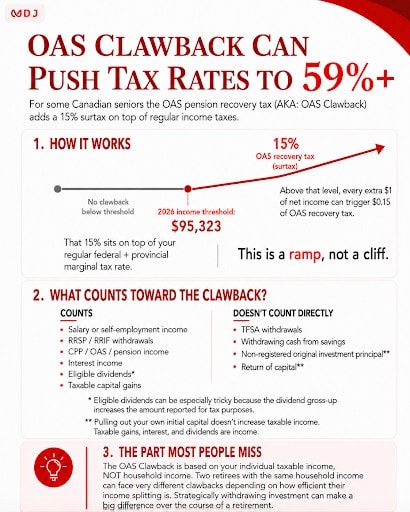
For 2026 income, the OAS recovery threshold is $95,323. Above that level, OAS is generally recovered at 15 cents per dollar of income until it is fully clawed back. A rental-property sale after 65 can push a retiree over that line because taxable capital gains and CCA recapture increase net income.
I’ve written before about why deferring your CPP is an excellent idea, and why deferring your OAS is a pretty good idea. I would not say that delaying both is automatically right for every Canadian retiree. Health, longevity, cash needs, GIS eligibility, and spouse’s age all matter, BUT, if you have a paid-off rental property that can be sold to fund the bridge from 60-something to 70, the usual objection to CPP deferral gets much weaker. You are not “losing” the government pension for five years. You are essentially using an illiquid, concentrated asset to buy yourself a larger indexed pension for the rest of your life.
You are also creating a big pile of liquid cash to enjoy retirement with! That sounds obvious, but I think landlords get caught in the same mental trap that dividend investors sometimes do. They become so accustomed to thinking of the rent cheque as “spendable income,” that selling the property feels like killing the Golden Goose.
But… say it with me… YOU. ARE. ALLOWED. TO. SPEND. YOUR. NEST EGG!
Robb Engen gives an example that I really like. Imagine a couple retires at 62 and sells an $800,000 rental. After tax and selling costs, perhaps they have roughly $720,000 left. Instead of asking, “How do we invest this $720,000 so that it generates exactly the same rent cheque?” they could decide to spend an extra $60,000 per year for their first five go-go years, then an extra $30,000 per year for the following five slow-go years.
That could mean more travel, a new vehicle, helping the kids, renovations, or simply having the freedom to say yes to things while they’re still healthy enough to enjoy them. Whatever remains, can stay invested as part of the retirement portfolio and provides a margin of safety later. I think that is a much healthier way to look at melting down a rental property.
The goal isn’t necessarily to replace $24,000 of rental income with $24,000 of dividends. The goal is to turn an illiquid asset into money that can fund the retirement you spent 30 years saving for.
Here is the basic runway I would be thinking about for many mom-and-pop landlords: The important point is not that every landlord should follow that exact timeline. The important point is that the timeline exists.
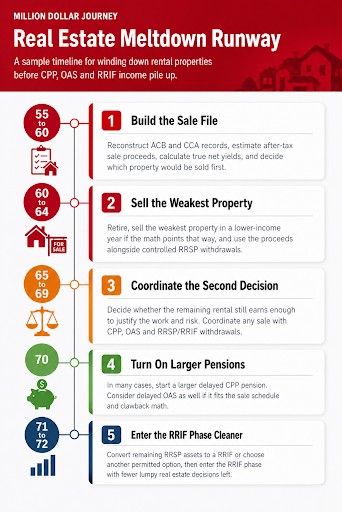
You do not want the first serious conversation about selling a rental to happen after one spouse gets sick, the property needs a six-figure repair, or the estate has to find cash to pay a massive final tax bill. A planned real estate meltdown gives you a chance to sell when the tax year makes sense, when you can wait for a reasonable offer, and when the money can still improve the years of retirement you are most likely to enjoy.
Do You Still Want to Run a Small Business?
There is one part of the real estate meltdown decision that doesn’t fit very neatly into a spreadsheet: Do you actually want to keep being a landlord?
It’s easy to call rental income “passive income.” Sometimes it really can feel that way. You get a good tenant, nothing breaks for six months, the rent gets deposited automatically, and owning a rental property looks like the greatest business model ever invented.
Then the furnace dies in February.
As I said above, being a mom-and-pop landlord is really more like running a small business than a passive income setup. You have customers (tenants), expenses, bookkeeping, insurance, legal responsibilities, capital expenditures and the occasional emergency that somehow always seems to happen while you’re away.
That might have been a perfectly reasonable tradeoff at 45. I’m much less convinced it’s a great tradeoff at 75.
Dave Chilton summed up his own feelings on rental properties pretty well when he recently said on a podcast:
“I’m 65-years-old soon. I don’t want to be dealing with all that stuff.”
Obviously, plenty of landlords feel differently. Some genuinely enjoy owning properties, like doing handyman work, have excellent long-term tenants, and can go years without much hassle. If that describes you, there is no financial planning rule that says you have to sell simply because you retired… but even then, I still think you should put a price on the work you’re doing.
Remember our earlier example of an $800,000 paid-off rental producing $20,000 of sustainable annual income. If the owner is doing all the tenant screening, bookkeeping, inspections, contractor wrangling and emergency calls themselves, we shouldn’t pretend those hours are free just because nobody sends them a T4.
In another world, you could have your $800,000 working for you in an all-in-one ETF (where you literally never have to look at it) AND you could be getting paid to do all that property manager work for someone else. Even if you don’t hate some aspects of being a landlord, I can’t imagine there are a lot of folks out there that want to do this work for free? Opening a Canadian online brokerage account and spending an hour a year on all this stuff starts to look pretty good!
This is also why I would include a realistic property-management expense when calculating the rental’s true return – even if you have no intention of hiring a property manager today. If the rental produces a 3% yield before management costs, and professional management plus additional maintenance coordination pushes that closer to 2%, that doesn’t automatically mean you should sell. It does mean you should understand what you are choosing to own.
Jason Pereira has made a similar point when looking at rental-property investments in a recent LinkedIn post. Once you strip away the excitement over historical appreciation and actually put all of the cash flows on the whiteboard, some supposedly incredible real estate investments look a lot more ordinary.
Retirement adds another consideration that I think gets overlooked: Who is actually running the properties… in other words, who is the key person in this small business?
In a lot of couples I’ve talked to, one spouse is very clearly “the landlord.” That person knows the tenants, has the plumber’s phone number, understands the bookkeeping, remembers when the roof was replaced and knows which drawer contains the lease agreements. If that spouse gets sick tomorrow, does the other spouse know how to take over?
That question gets increasingly important as you move through your 70s and 80s.
Before deciding that you’ll simply keep the rentals forever, I’d ask:
- Do I still enjoy managing these properties?
- What would it cost to have someone else do most of the work?
- Would I still keep the property if that management cost reduced my net return?
- Do I want tenant and repair problems interfering with travel or other retirement plans?
- Could my spouse comfortably manage the properties without me?
- Do my kids actually want these properties – or am I leaving them a part-time job they don’t want?
I’ve heard many landlords say some version of, “We’ll just leave the properties to the kids.” Maybe that’s exactly what the kids want… but I wouldn’t assume it. Your children might prefer a diversified investment account that can be divided in five minutes over becoming co-owners of a duplex with their siblings. Remember, this isn’t a choice between inheriting an excellent property or nothing. It’s a choice of one type of asset or another equally valuable (maybe more valuable) asset.
Selling a rental can eliminate some investment return, but it can also eliminate tenant calls, concentrated risk, major surprise expenses, record keeping, and a future problem for the surviving spouse.
Case Study: Two Paid-Off Rentals – Can Mark and Lisa Actually Retire?
Let’s put all of this together by looking at a realistic mom-and-pop landlord couple.
Mark and Lisa are both 60 and live in Ontario. Mark earns about $115,000 per year as a regional sales manager for a building-supply company, while Lisa earns about $85,000 as an operations manager for a privately owned professional-services firm. They’ve both had good careers, but neither has a defined-benefit pension waiting for them. They raised two kids, bought their own home in their 30s, and then did what a lot of successful Canadian landlords did during the 2000s: bought one rental, eventually added another one, and spent the next couple of decades aggressively paying down mortgages.
They were always more interested in killing debt than maximizing RRSP contributions, so they enter retirement with a relatively modest $400,000 combined in RRSPs, plus $200,000 in TFSAs. Their own $900,000 house is paid off. Rental A is an older detached house worth about $700,000, while Rental B is a duplex worth roughly $850,000. Both rental mortgages are gone as well.
In other words, Mark and Lisa have done exceptionally well. Their net worth is about $3.05 million. They also look at each other and wonder why people worth $3 million are still feeing nervous about quitting their jobs.
Their questions are pretty straightforward:
- Can we retire now?
- What sort of budget can we actually afford?
- How do we get from this pile of houses and registered accounts to something that resembles a normal retirement portfolio?
For simplicity, I’m going to keep everything in today’s dollars.
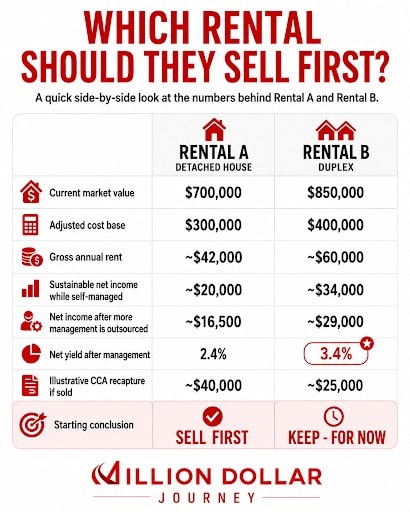
Rental A is an older detached house worth about $700,000, with an adjusted cost base of $300,000 and gross annual rent of roughly $42,000. It currently produces about $20,000 of sustainable net income while Mark manages it himself. Once more of that work is outsourced, I estimate the net income falls to roughly $16,500, or about a 2.4% yield on the property’s current value. For the purposes of our example, we’ll assume that the accountant determines there would be about $40,000 of CCA recapture if it were sold.
Rental B is the $850,000 duplex. Its adjusted cost base is $400,000, gross rent is approximately $60,000, and sustainable net income while self-managed is about $34,000. After more management is outsourced, I estimate roughly $29,000 of annual net income, or a 3.4% yield. We’ll assume the accountant calculates about $25,000 of potential CCA recapture.
The Property Manager Changes the Math
This is one place where I think retirement planning should be more pessimistic than the landlord’s historical spreadsheet.
Mark has done most of the property-management work himself for 20 years. He knows the tenants, has the plumber’s number in his phone, does minor repairs himself, handles the bookkeeping and can usually figure out what’s wrong from a photo someone texts him.
He also has absolutely no desire to spend his 70s doing that.
Consequently, I don’t want to calculate these properties’ retirement returns based on the assumption that 75-year-old Mark will continue supplying free labour indefinitely. Let’s assume Mark and Lisa increasingly outsource management and coordination as they get older. If we use something in the neighbourhood of 8% of gross rent plus a little additional allowance for leasing and coordination costs, Rental A’s sustainable income drops from around $20,000 to $16,500, while the duplex falls from about $34,000 to roughly $29,000.
The properties haven’t suddenly become worse investments. We’ve simply stopped pretending Mark’s labour is free. Rental A is now producing about 2.4% on $700,000 of equity. Rental B is producing about 3.4% on $850,000.
So now the question becomes: If Mark and Lisa had $700,000 sitting in cash today, would they deliberately put all $700,000 into Rental A in order to earn $16,500 per year before personal income tax?
If the answer is no, then we have some work to do.
Age 60: Retire First, Sell Second
The first thing I would tell Mark and Lisa to do is retire.
Not sell both properties. Not start CPP. Not pull $100,000 out of their RRSPs.
Just retire.
They are coming off roughly $200,000 of combined employment income. If we already think Rental A should be sold, there is very little reason to deliberately stack a large taxable capital gain and possible CCA recapture on top of their final high-income working year.
Instead, age 60 becomes the boring preparation year. They get their accountant involved and reconstruct the adjusted cost base and CCA history for both properties. That means purchase documents, legal bills, land-transfer-tax records, invoices for capital improvements and old rental tax schedules. They also get realistic market valuations and make sure the accountant knows how the original purchase prices were allocated between the buildings and the land.
Land itself is not depreciable, so CCA is connected to the building portion of the property. CRA calculates recapture using the capital cost and remaining undepreciated capital cost of the depreciable property. Consequently, I would never try to determine a landlord’s real CCA bill by saying something like, “Well, you claimed $1,500 per year for 20 years, so your recapture must be $30,000.”
For our example, let’s assume Mark and Lisa’s accountant goes through the actual records and concludes that Rental A would generate approximately $40,000 of CCA recapture if sold, while Rental B would generate approximately $25,000. Those are illustrative numbers, but they are meant to represent actual recapture calculations based on historical CCA and UCC records rather than some arbitrary percentage of the sale price.
Age 61: Sell the 2.4% Rental
Mark and Lisa retire at the end of the year they turn 60, and they book their final year of taxable income from their jobs. The following year, Rental A goes on the market.
Rather than automatically assuming a 5% realtor commission, let’s say they negotiate total brokerage compensation of 3% of the sale price. Add HST on that commission and roughly $2,000 in legal costs, and their selling expenses come to around $26,000.
The simplified capital-gain math now looks like this:
$700,000 sale price – $300,000 adjusted cost base – $26,000 selling costs = $374,000 capital gain.
Under current rules, 50% of that capital gain (roughly $187,000) is included in taxable income. Then we add our assumed $40,000 of CCA recapture, which is separate from the capital gain, and generally included as ordinary income.
Because Mark and Lisa own the property 50/50, each spouse is roughly looking at $93,500 of taxable capital gain plus $20,000 of recapture. They also each have about $14,500 of net income from the remaining duplex.
That gets each of them to roughly $128,000 of taxable income in our simplified sale year.
That’s going to garner them an average tax rate of around 23% (marginal rate is 43.4%). It’s not great, but it’s a heck of a lot better than adding that same property income on top of Mark’s $115,000 salary and Lisa’s $85,000 salary. This is really the whole point of the tax-window concept. We aren’t making the gain disappear, we’re deliberately realizing it during years when there is less other income fighting for the same tax brackets.
Using 2026 Ontario tax rates as a rough illustration, Mark and Lisa could wind up with something in the neighbourhood of $610,000 from Rental A after selling costs and the additional income tax generated by the sale.
Sidenote: Please do not take that number to your accountant and say, “That guy on the interest says I get $610,000.” The real number could easily move by tens of thousands of dollars depending on adjusted cost base, CCA history, land-versus-building allocation, selling commission, other deductions, other income, and the province you live in.
But $610,000 is plenty accurate for the decision we’re trying to make.
Mark and Lisa have transformed $700,000 of trapped equity producing roughly $16,500 per year into approximately $610,000 of liquid after-tax retirement capital.
Now retirement starts to look a lot different.
What Do They Actually Do With the $610,000?
This is where I think there are several perfectly reasonable versions of a real estate meltdown. Robb Engen’s spend-earlier approach appeals to me because he’s willing to acknowledge the shocking possibility that retirees might want to spend retirement money during retirement.
But Mark and Lisa don’t have to sell Rental A and immediately book five years at the Four Seasons either.
They can decide how aggressively they want to shift money from future net worth into their current lifestyle.
At the aggressive end, they could earmark roughly $200,000 for extra spending over the first five years (about $40,000 per year) and leave roughly $410,000 initially invested.
At the other extreme, they could spend very little of the sale proceeds, perhaps setting aside $0-$50,000 for extra lifestyle spending while leaving roughly $560,000-$610,000 invested for the long term.
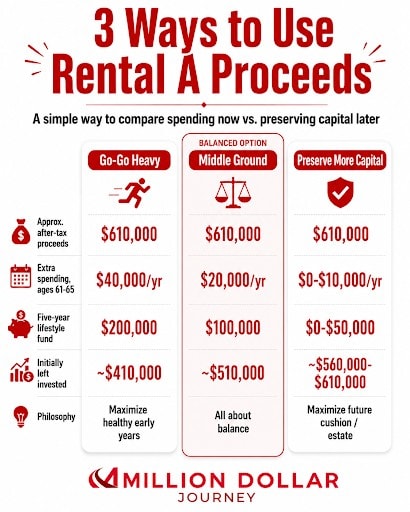
I like the middle ground for these two. They earmark about $100,000 for the first five years of retirement, spending an extra $20,000 per year while they are healthy and active, and leave approximately $510,000 of the proceeds invested.
This money has one job: Get spent before age 66.
That gives them an extra $20,000 per year for five years. Maybe that means two trips each year. Maybe a new vehicle is in there. Maybe they rent somewhere warm for six weeks each winter, help the kids, take the entire family on a trip, or finally renovate something in their own house. Whatever brings joy!
The planning point is that nobody gets an award for selling Rental A, investing every penny in their Qtrade account, and then becoming terrified to sell the ETFs.
YOU. ARE. ALLOWED. TO. SPEND. YOUR. NEST EGG!
So What Can They Actually Afford?
This was Mark and Lisa’s original question, and now we can finally give them an answer.
Their target is $75,000 per year after tax for normal retirement spending, with larger trips and other go-go purchases sitting above that number.
After Rental A is gone, the professionally managed duplex still produces roughly $29,000 of taxable income.
Mark and Lisa also have $400,000 combined in RRSPs. That’s meaningful money, but split between two people it is not some terrifying future RRIF time bomb. Consequently, I wouldn’t aggressively drain the RRSPs just because we happen to know what an RRSP meltdown, but I would use the low-income years.
In a normal year when they are not selling a property, suppose Mark and Lisa each withdraw approximately $25,000 from their RRSP. Add about $14,500 each from the duplex and they’re each reporting roughly $39,500 of taxable income.
Using current Ontario taxation as a rough approximation, that gives the couple something around $69,000 of after-tax cash from the $50,000 of RRSP withdrawals and $29,000 of rental income.
They need only another roughly $6,000 from their TFSAs or the Rental A sale proceeds to hit their $75,000 normal spending target.
That’s it.
They don’t need CPP.
They don’t need OAS.
They don’t need to sell the duplex tomorrow.
They can retire.
And this is all assuming that the proceeds of selling Rental A have no RRSP or TFSA to go into. If we had some contribution space available (which they probably would) then you get even more after-tax income available.
Their lifestyle during their early 60s therefore looks roughly like: $75,000 normal after-tax retirement spending + $20,000 of deliberate go-go spending = approximately $95,000 per year.
That’s a much more useful answer than telling two people that their net worth is $3.05 million.
Age 65: Do They Really Need CPP?
Let’s assume Service Canada estimates Mark’s CPP at $1,150 per month at 65, while Lisa is projected to receive $900 per month. That gives them a combined age-65 CPP of $24,600 per year.
Those are reasonable CPP amounts for two people who have had good careers without necessarily making maximum contributions every single year. Lisa may have spent some time away from work when the kids were young, their salaries were lower earlier in their careers, and neither needs a perfect contribution history for our example to work.
Do Mark and Lisa need to start CPP at 65?
Nope.
They still have the remaining Rental A proceeds, their TFSAs, some RRSP money and the duplex.
Under Service Canada’s current rules, delaying CPP from 65 to 70 increases the pension by 0.7% per month, or 42% over five years. Their $24,600 annual age-65 CPP therefore becomes roughly $34,900 per year at 70, before future indexing.
They have essentially used part of a mediocre 2.4%-yielding rental property to finance a five-year bridge that gets them another $10,000-ish of indexed CPP income every year for the rest of their lives.
I really like that trade… and I’m not even being totally fair to it. Because CPP gets indexed use wage inflation instead of cost inflation when you defer it, the actual real-life increase to the buying power of your CPP is going to be around 50% (rather than the 42%). So it’s an even better trade than it initially looks on paper.
OAS is a separate decision, but I would lean toward delaying it as well if we still intend to sell the duplex before age 70. Service Canada allows OAS to be delayed to age 70, increasing the eventual benefit by up to 36%. More importantly in this example, why deliberately start receiving an income-tested benefit at 65 when we already know there may be another large rental-property gain landing on their tax returns at 66 or 67? That would likely mean a big chunk (maybe all) of their OAS would get clawed back for that year anyway!
If Mark and Lisa delay both CPP and OAS to 70, they could arrive there with roughly $35,000 of combined CPP plus another $24,000-ish of combined OAS in today’s dollars.
We’re now approaching $60,000 per year of indexed government pension income before selling a single ETF unit or making a RRIF withdrawal!
Again, melting down the rental properties didn’t destroy their retirement income.
It helped create an objectively better version of it.
Age 66 or 67: Run the Duplex Test Again
At 61, the duplex was producing about a 3.4% net yield after professional management, which was substantially better than Rental A, so we kept it.
Five or six years later, run the calculation again.
Maybe rents have risen faster than expenses and the yield now looks better. Maybe the tenants are fantastic. Maybe the property manager has made the whole thing painless.
Fine. Keep it another year or two, but my bias would still be toward selling.
By this point Mark and Lisa have proved that they can live comfortably without two rent cheques. Their portfolio is more liquid. Their RRSP balances have been reduced. They’ve enjoyed several excellent go-go years. Larger CPP and potentially OAS payments are sitting there waiting for them at 70.
And the duplex is still asking them to leave $850,000 sitting in one building in exchange for approximately $29,000 of annual net income. That’s tough to justify.
Let’s say their accountant confirms our assumed $25,000 of potential CCA recapture on Rental B. Using the same selling-cost assumptions as before, an $850,000 sale might incur about $31,000 in brokerage, HST and legal costs.
Our simplified capital-gain calculation therefore looks like: $850,000 – $400,000 adjusted cost base – $31,000 selling costs = $419,000 capital gain.
Half of that – approximately $210,000 – is taxable under the current inclusion rate. Add the $25,000 of illustrative CCA recapture and we have roughly $235,000 of taxable income generated by the sale.
Split 50/50, that’s approximately $117,000 per spouse before any other income.
Consequently, this becomes another year when I’m not particularly interested in making large discretionary RRSP withdrawals. The property sale has already filled those tax brackets for us. Using the same simplified Ontario assumptions, they might keep somewhere around $760,000-$765,000 of liquid capital from the duplex after selling costs and the incremental tax generated by the sale.
Combined with the proceeds from Rental A, Mark and Lisa have now potentially converted roughly $1.37 million of rental-property equity into after-tax liquid capital, before accounting for portfolio returns or the money they’ve deliberately spent along the way.
They didn’t illegally cheat taxes… they simply controlled when it showed up.
What Did the Real Estate Meltdown Actually Accomplish?
When Mark and Lisa retire, they have $1.55 million tied up in two rental properties. Those rentals produce roughly $45,500 of sustainable annual income after allowing for the increasing cost of professional management. About 72% of their investable assets are concentrated in those two properties. They have $400,000 combined in RRSPs, their age-65 CPP would be roughly $24,600 combined, and they still have two large deferred property-tax liabilities waiting somewhere in the future.
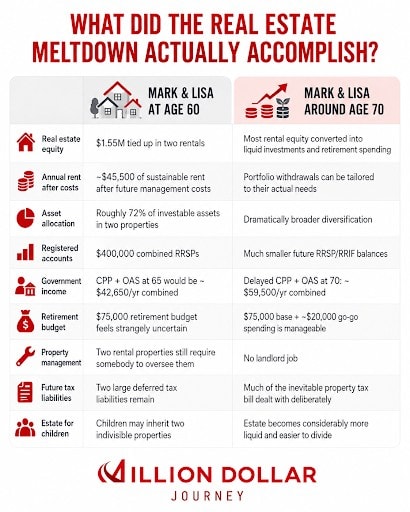
Around age 70, the picture is very different. Most of the rental equity has been converted into liquid investments and actual retirement spending. Their withdrawals can be tailored to what they need rather than dictated by rent cheques. Their portfolio is dramatically more diversified. Their RRSP balances are smaller after several years of controlled withdrawals. Their delayed CPP is roughly $34,900 combined, and the property sales can be completed before delayed OAS begins.
Most importantly, the original $75,000 retirement budget that somehow felt uncertain when they were $3x millionaires now looks completely manageable. They have also been able to spend roughly another $20,000 per year during their early go-go years without pretending that every dollar of their nest egg has to survive them.
They no longer have two rental properties that somebody has to oversee. Much of the inevitable tax liability has been dealt with on their timetable rather than somebody else’s, and instead of eventually leaving their children two indivisible properties, they have a substantially more liquid estate that is easier to manage and divide.
At retirement, Mark and Lisa have approximately $2.15 million of investable assets outside their own house: $1.55 million in rentals, $400,000 in RRSPs and $200,000 in TFSAs.
About 72% of their investable wealth is sitting in two buildings.
The real estate meltdown doesn’t magically make them richer. It makes the wealth they already built usable.
Depending on how much the portfolio returns (both inside and outside of the registered accounts) Mark and Lisa are very very likely to be able to spend more than the $75,000 they have targeted as a baseline for a retirement budget. In fact, they’ll probably be able to withdraw $80,000 from their portfolios pretty safely, if their plan is to “Die with Zero.” Once combined with their CPP and OAS, we’re looking at a very healthy 140,000ish taxable income between the two of them.
Now, that could lead to us spending even more aggressively in the go-go years of initial retirement, but I wanted us to increase the odds of passing along wealth to the estate so that Mark and Lisa could see an apples-to-apples comparison of “what if we just left it behind for the kids?”
What If They Just Leave Both Rentals to the Kids?
here is one final argument that comes up all the time: Why voluntarily trigger all this tax? We’ll keep the properties, one spouse can inherit them when the other dies, and eventually we’ll leave both rentals to the kids.
The first part can indeed work. Under CRA’s spousal-rollover rules, capital property can generally transfer to a Canadian-resident surviving spouse on a tax-deferred basis. So if Mark dies first and leaves his interests in the rentals to Lisa, the capital gains do not necessarily have to land on Mark’s final return.
But notice the wording: tax-deferred.
Not tax-free.
If Lisa later dies while still owning both properties, she is generally deemed to have disposed of them at fair market value immediately before death. At that point the accumulated gains can hit one person’s final tax return at the same time plus the CCA recapture.
Let’s make the estate comparison ridiculously favourable and assume both properties are still worth only today’s $700,000 and $850,000 decades from now. No appreciation whatsoever.
Rental A has a $400,000 gain before considering selling expenses, while Rental B has a $450,000 gain. Together that is $850,000 of capital gains. At today’s 50% inclusion rate, $425,000 would be taxable. Add our illustrative $65,000 of combined CCA recapture and we have approximately $490,000 of taxable property income landing on Lisa’s final return.
That’s before any RRIF income, CPP, OAS, investment income or other taxable amounts that may also appear in the year she dies.
When Mark and Lisa sell gradually, we’re using two people, two sets of tax brackets and multiple tax years. A substantial portion of the taxable property income lands in middle tax brackets. Using current Ontario rates, our staggered sales generate an effective average tax rate somewhere in the mid-20% range on the taxable income associated with selling the rentals. Concentrating roughly $490,000 on one final return could push the average tax rate on that income close to 50%!!
Depending on the exact assumptions, we could easily be talking about something approaching $100,000 more income tax simply because the gains were concentrated on one final return instead of deliberately realized across two spouses and multiple retirement years.
And remember how generous I’ve been to the “leave it to the kids” strategy. I’ve assumed the properties never appreciate another dollar.
If Mark and Lisa keep those buildings for another 20 or 30 years and property values continue rising, the eventual capital gains get larger. If Lisa also has RRIF income in her final year, more of the property income can start higher up the tax brackets, and somebody still has to come up with the cash to pay CRA.
So whenever I hear: “We’ll just leave the rentals to the kids so we don’t have to pay the tax.”
What I translate that into is: “We’ll give a lot more tax to the CRA and live a much lower lifestyle in retirement than we could afford to.”
That’s not automatically wrong. Maybe the children desperately want the rentals. Maybe there are other estate-planning reasons for keeping them.
But it should be a conscious choice.
Rental A wasn’t a failure. Rental B wasn’t a failure.
They were successful accumulation assets that helped Mark and Lisa become millionaires.
They did their jobs.
Now Mark and Lisa get to decide whether those same buildings are still the best assets for the job they need done next: funding a comfortable retirement, spending more money while they’re healthy enough to enjoy it, building larger indexed pensions for later life, and eventually leaving their kids a portfolio instead of a giant tax bill and the plumber’s phone number.
The Cost of Waiting
There is one number from the Mark and Lisa example that I think is worth dwelling on.
Under our real estate meltdown, the two property sales create roughly $490,000 of taxable income in total once we account for the taxable portions of the capital gains, our assumed CCA recapture, and the remaining rental income in the first sale year. The key is that we spread that income between two people and two different tax years. Using 2026 Ontario tax rates as a rough approximation, the combined tax bill across those sale years comes out around $119,000 – an average tax rate of roughly 24% on that taxable income.
Now imagine Mark dies first and the rentals transfer to Lisa using the normal tax-deferred spousal rollover. CRA generally allows that tax to be postponed until Lisa eventually sells the properties or is deemed to dispose of them herself. If she dies still owning both, and we use the exact same property values from our example – no additional appreciation whatsoever – the two gains plus our illustrative CCA recapture would create roughly $490,000 of taxable income on Lisa’s final return. Using the same 2026 Ontario tax rates, that produces a tax bill of roughly $218,000, or an average tax rate of about 44%.
That’s almost $100,000 of additional tax without Mark and Lisa becoming one dollar wealthier.
And I’ve made the “keep everything until death” scenario unusually generous. I assumed the rentals never increase in value again, and I haven’t stacked CPP, OAS, RRIF withdrawals or other taxable income onto Lisa’s final return. Ontario’s current combined marginal rate reaches 53.53% once taxable income gets high enough, so the eventual result could easily be worse.
This is the part that sometimes gets lost when landlords say they don’t want to sell because of the capital-gains tax. Tax deferral is valuable, but there eventually comes a point where continuing to defer doesn’t mean paying less tax, it can mean deliberately saving a whole bunch of income for the highest tax brackets you’ll ever face.
The Real Estate Meltdown Checklist
If I were approaching retirement with one or more paid-off rentals, I wouldn’t start by asking whether Canadian real estate is going up or down next year. I’d want four numbers:
- What is each property actually yielding today after realistic expenses and professional management?
- How does that compare to what a diversified investment portfolio would produce?
- How much money would I really have left after selling costs, capital-gains tax and CCA recapture?
- What would the tax bill look like if I sold during my lower-income retirement years?
- What happens if I don’t sell, and eventually several decades of gains land on one surviving spouse’s final tax return?
Once you have those numbers, the decision tends to get a lot less emotional.
Maybe the best property still earns its place and you keep it. Maybe the weakest one gets sold at 61 and another at 67. Maybe you spend more during your first decade of retirement. Maybe you use the proceeds to delay CPP and OAS. There isn’t one perfect real estate meltdown schedule or rulebook.
The real estate meltdown isn’t about predicting the top of the housing market. It’s about choosing the exit while you still have the tax brackets, the time, and the health to choose it.