
Toolbelt vs. Textbook: The $335,000 Case for Skilled Trades

I was talking to my friends Bryce and Kristy (authors of Quit Like a Millionaire and Parent Like a Millionaire) the other day and we got to chatting about AI, possible impacts on the workforce, and the difficult career choices facing young adults right now.
Now, as someone who used to teach high school, I’ve long been a huge advocate for the trades career path. I’ve always contended that very few people understand how much further ahead financially a tradesperson can be relative to a university grad – especially if they also happen to be financially literate. When you look at the hard math, the massive opportunity cost of spending 4-5 years in university is really hard to “catch up on” compared to someone earning a solid wage right away.
In the current context of AI anxiety, trades are one of the few areas where one could argue there is genuine security from job loss going forward. With a guaranteed shortage of millions of tradespeople across North America for the foreseeable future, it slants things even more strongly to the trades when looking at long-term career prospects.
“Isn’t That Work Kind of Dirty?”
Bryce and Kristy largely agree with my trades-are-awesome recommendation, but they had recently been talking to a friend with a child in high school. They had been discussing career options and when trades were brought up as a worthy consideration, the general response was, “Um… isn’t that work kind of dirty, and don’t they have to do super physical work? I just don’t think they’d be happy as a tradesperson.”
Now, this didn’t surprise me a whole lot. Not because it’s accurate, but because I’m quite familiar with the ridiculous stigma around the trades. I grew up around no-collar and blue-collar workers. Many of my childhood friends are operators or tradespeople. I used to be surprised at the misconceptions that surround professions such as plumbers, electricians, carpenters, and mechanics – or my personal favourite: heating, ventilation, and air conditioning (HVAC).
Sidestory: The first time I saw the insane amount of money HVAC people were able to charge me to come in, hook up one gauge, do a 2-minute refill of the refrigerant, and then fill out an invoice – I realized this was the cheat code to life.
To directly address the concept of “Does a tradesperson do super physical work?” is quite difficult because there is such a wide variety of trades out there, and some are more physical than others. While I certainly know some tradespeople in their late forties and fifties who need shoulder surgery, or deal with consistent back pain, it’s not like sitting at a computer all day is great for you either.
My dad worked in the lumber harvesting industry his whole life and I know for sure that his job was more dangerous and physically demanding than the vast majority of trades jobs out there. The same goes for most types of agriculture (go ahead and Google “agricultural fatalities Canada” or “childhood farm injury rates” if you want some eye-opening stats), as well as commercial fishing. Heck, my friends that worked unloading bags at the airport and as industrial butchers had substantially more wear and tear on their bodies than most tradespeople I know.
Now, do tradespeople get their hands dirty? Maybe… but… uh… there are worse things in life?!
The HVAC guy that came to my house didn’t get dirty. Sure, carpenters and welders have to deal with some stuff that isn’t pleasant from time to time, but have you ever smelled a middle-school classroom after lunch on a scorching hot day? There’s a reason they call it work.
The real question is: What do you get in exchange for the tradeoff of sore joints, the occasional day spent out in the elements, or having to lift heavy stuff once in a while?
All things being equal, most people would probably choose the cushy job where they can work from home – but that’s the whole point: Everything isn’t equal.
The Wealthy Welder
One of my favourite stories to share when I talk about unique opportunities in the trades is the story of my family friend Owen.
I met Owen when he was about eight years old, and saw him each year at our cottage in the summers (his family owns a site very close to my in-laws’ cottage). Watching him grow up, I’d say he was almost a perfect representation of a lot of fellas from our rural neck of the woods. Nice guy, maybe slightly-above-average grades, not big on sitting still for long periods, not particularly in love with any idealized career, and solid job experience in a variety of physical work settings. In short – great dude, decent social skills, but nothing on his resumé would jump off the page at you.
Owen made about $200,000 last year working only 7 months… as a 22-year-old.
Is Owen some sort of international assassin for hire you might ask?
Nope. He gets paid a lot of money to swim underwater, and use a torch to attach one piece of metal to another. It’s not easy work, and while it’s not academically-difficult, I’d say that it’s demanding in that getting specific details right clearly matters a lot. There’s also an element of danger if precautions are ignored.
It’s also not backbreaking labour – and I’d argue that it’s probably pretty darn interesting a lot of time!
I should note that Owen’s pay isn’t the norm for underwater welders. He is willing to travel to isolated places for weeks at a time, and work long hours. In exchange for that tradeoff, he gets a ton of vacation time and a huge paycheque. I doubt that Owen will want to do that forever, and will probably settle for jobs closer to home if/when he decides to become a family man. He also doesn’t have long-term job stability on any one specific job site. While it looks like there will be worldwide demand for his skills for the foreseeable future, it’s difficult for him to know where he’ll be from one season to the next.
Owen never read Bryce and Kristy’s book, so he didn’t intentionally set out to follow their advice about choosing a career path. That said, he reached the same conclusions they did. From grade 10 onwards, Owen had a pretty strong feeling that his future lay in a field that didn’t involve reading a lot of text, or doing high-level calculus.
Other than that, he didn’t really know what he wanted to do – but he wanted to make money sooner rather than later. When he looked at jobs he didn’t mind doing, and then stuff he was good at – both swimming and welding were on the list. If he could get paid more money to weld while he was swimming, then why not?
From what I can tell, Owen basically had two major advantages over many young Canadians. First, he had some experience with physical labour, and knew that while physical labour wasn’t fun, it also wasn’t that bad. Definitely not something to be scared of. The other major advantage he had over most young people was that he was extremely focused on his goal. Once he found out about the financial opportunity of being an underwater welder, he set his sights on it and worked towards that north star.
He definitely didn’t make big bucks right away. First he had to climb the dual ladders of diving knowledge and welding proficiency, then gradually build his skills and reputation on the job. That said, he earned a solid paycheque every step of the way. He’s now earning a doctor’s wage at an age when most doctors are still facing years of medical school and residency, as well as likely $100,000+ in student debt.
Being underwater all day isn’t everyone’s cup of tea. The day-to-day life of a welder isn’t something they make a lot of movies about. There are obviously tradeoffs. But Owen got to work making those tradeoffs before he was legally allowed to buy a beer, and consequently he gets to do whatever he wants five months of the year, while making a top 1% paycheque. Those tradeoffs seem pretty logical to me!
Sadly, Owen didn’t take my personal finance course in high school, and doesn’t appear super interested in putting his big paycheque to work… but he’s getting the majority of the big things right, and still has a lot of time to come around on the whole investing thing.
Owen’s story isn’t typical within the trades, but I wanted to share it because it illustrates what’s possible. When I tell people his story it never fails to pique their interest.
Dan the Man Gives His Teacher a Lesson
In case you are thinking that all of this trades stuff is too good to be true, I want to go the extra mile here to assure you that it’s not.
I first became aware of the opportunities trades presented to young people when I was in my third year of teaching. I had worked my way through high school, then university, earning high grades in my first degree so that I could start taking a second degree in Education. I figured that I had played the game… and won.
I had won the prize of a very solid, dependable salary, at a relatively young age. I had made it through university taking the maximum allowable course load. I had worked hard, and then realized the benefits!
Then I looked over one day, and one of my brighter grade 11 students named Dan was driving a nicer vehicle than his teachers were! I asked him how he managed that. He is a humble guy, so he just kind of smiled shyly and explained that he took his graduation prerequisite courses in the morning, and then went and worked as a machinist all afternoon. He got paid good money, and got course credits for it. That was the plan for grade 12 as well.
It was the first time in my life that I had even considered that working at a trade was a great plan. Boy… did I feel uneducated.
Like most Canadians, I had drunk the expensive university Kool-Aid. Everyone had told me that going to university was by far the most direct path to an upper-middle-class lifestyle. Getting your hands dirty was for the people that weren’t smart enough or motivated enough to keep to that “higher path.”
The system had worked in a wide variety of ways to make sure that I felt people who worked with their hands (even if they had to do a lot of critical thinking as their hands were working) were somehow going to be seen as less than. After investing all that time and money into a university education, there is a temptation to continue the tradition of believing you MUST be higher status, because otherwise… what did you just do all that for?
It certainly wasn’t for the money.
Just to make sure I wasn’t misremembering, I got in touch with Dan, and asked him if I had the facts right. He confirmed:
- He worked in the afternoons and got paid $19 per hour (about $25 per hour inflation-adjusted for today).
- He earned 8 high school credits that counted towards his diploma.
- He banked enough apprenticeship hours that he was able to get both his level 1 and level 2 completed in his first year out of high school (before he turned 19).
- His registration fees for the apprenticeship program were waived since he was in high school ($400 value).
- He was able to challenge his level 1 apprenticeship and completely skip that first block of college time.
I also remembered that Manitoba wanted to encourage tradespeople to work with high school kids so badly, that they helped fund their salary. As of today, an employer hiring a student through the Manitoba High School Apprenticeship Program can get 25% of the student’s wages back on their taxes (up to $5,000 per year). So the province is even willing to make this a great deal for the employer too!
This sort of support can only be found in a few provinces, but there is some sort of high school apprenticeship program to be found pretty much right across Canada.
Passion Isn’t a Career Plan
One of the interesting things about discussing all of this with Kristy and Bryce is that they literally wrote the book on choosing a career in a smarter way. They were among the first writers I came across who were willing to challenge the conventional Millennial wisdom that you should simply “follow your passion” and everything else would somehow fall into place.
As much as I have a soft spot for that sentiment, I can tell you that it’s incredibly confusing advice for most high school students. The vast majority have no idea what they’re going to love doing for the next forty years. To make matters worse, they’re usually relying on advice from parents, teachers, and guidance counsellors who (through no fault of their own) have fairly limited career experience themselves.
Most of us only work a handful of jobs over our lifetime, and we’ve typically only followed one post-secondary path. So how, exactly, are we supposed to confidently advise teenagers about the hundreds of career options available to them?
In their book and on their blog, Bryce and Kristy explain that they put quite a bit of thought into what they wanted out of a job and what they wanted out of life. Their eventual big picture theory can be summed up in this Venn Diagram:
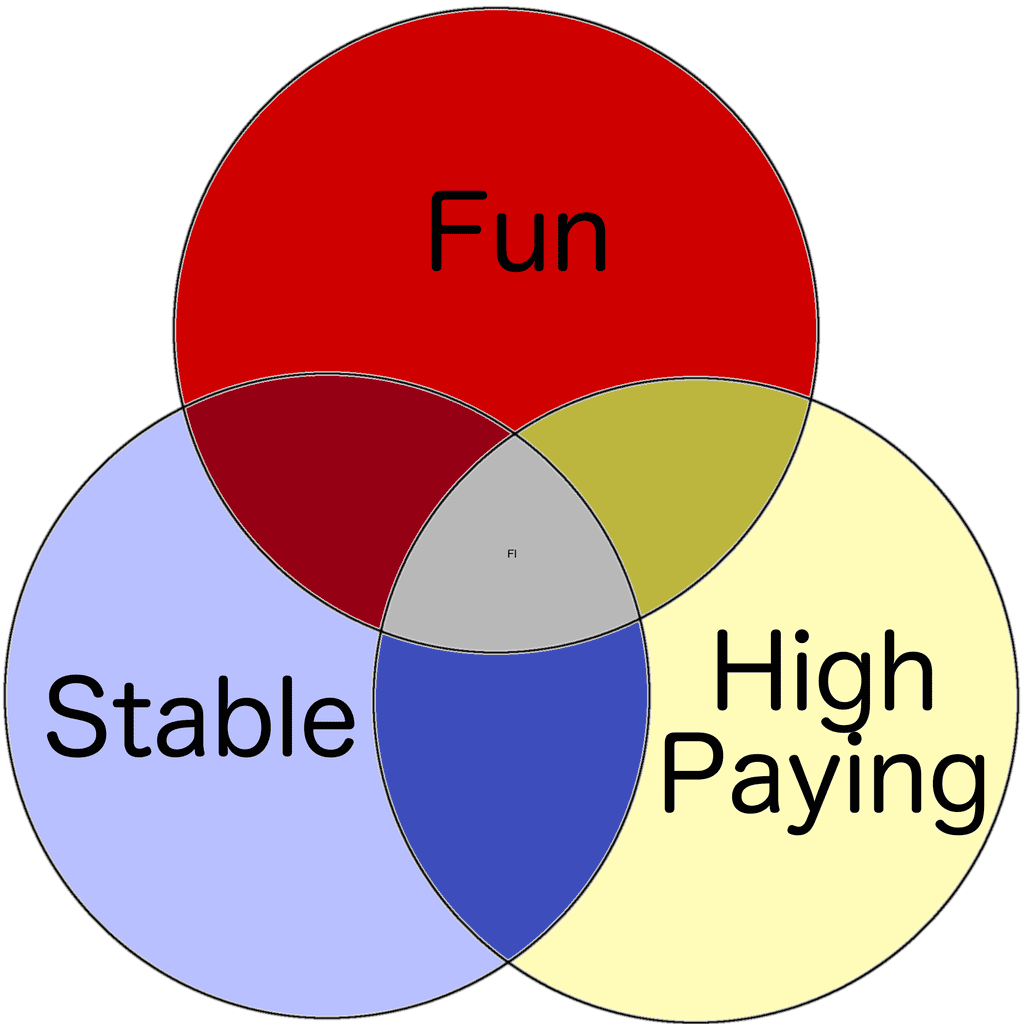
The idea is you get to pick two of these three priorities. The little FI in the middle stands for Financial Independence, because once you actually have enough of an investment portfolio to do whatever you want, then you truly get to embrace all three pillars of a great life.
Kristy and Bryce patiently explain that very few people get to “do what they love” and make a lot of money doing it. It’s actually much more useful advice to tell folks: Take a look at what you’re good at, then what you don’t mind doing (hey, if you love it, even better), and then what you can get paid to do.
The duo’s motto when evaluating future scenarios is “Let’s Math **** Up!” So it should come as no surprise that they advocate for quantifying future career paths with a simple formula called Pay Over Tuition:

While that formula is a great filter for traditional university degrees, it kind of breaks down when we try to use it to evaluate the trades. That’s because, in most provinces, students can begin earning high school credits, apprenticeship hours, and a paycheque, all before they turn 18!
That’s worth re-emphasizing: You can get paid good money just to go to high school AND get a jump start on your post-secondary career path!
Then, if that wasn’t enough of an advantage for you, governments have spent years trying to encourage more young people to take up the trades. Consequently, there are a surprising number of trade-specific scholarships, grants, and apprenticeship incentives available.
But that’s not the best part. The really shocking thing is that when you go to college for trades-based classroom training it doesn’t cost you anything. In fact, you’ll get paid to go to school!!
Ok… I might be slightly embellishing the truth there. The more nuanced story is that most trades career paths are broken up into apprenticeship levels. Typically a level requires about 10-15 weeks of classroom time, followed by 1,000-1,500 work hours. The details vary a bit depending on the specific trade.
What really matters here is that you can collect employment insurance (EI) while you go to college. Not only that, but the government is then going to top up those EI payments by sending you an extra $400 per week that you’re in session. Plus, those college courses are much cheaper than university courses to begin with!
So a typical level of apprenticeship for a tradesperson (there are usually 3 or 4 levels) might involve going to college for a few months, and forking over $2,000 in tuition. In some provinces, the government will even subsidize that small amount. For example, in Manitoba, a construction electrician only pays about $600 out of pocket for each 10-week training block (the provincial government pays the rest).
Then, assuming you were working before going to your college training block, you are eligible to collect EI. Depending what your income was at the time (EI is paid out at 55% of your taxable earnings) you can max that EI payment out at $729 per week. Then, the new Apprenticeship Training Grant is going to add another $400 per week to that (lifetime max of $16,000).
If you’re following along, that means that for a 12-week course, an apprentice might pay $2,000 (or not), but they are also collecting over $10,000 in government cash while they attend that 12-week course! That is just an absolutely crazy value relative to a typical university experience. It also turns Kristy and Bryce’s POT formula on its head, because what happens when your education not only doesn’t really cost anything, but instead it actually pays you to go to school?
Case Study: Paid to Learn vs Paying to Learn
Ok, so in the spirit of “Math **** Up!”, let’s use some hard numbers to explain to a friend of a friend why they need to set aside their inherent anti-trades biases. We’re going to compare real numbers for an average-ish representative of the blue collar and white collar world.
Now if I really wanted to slant this thing, I’d compare my underwater welder to someone who was crazy enough to take a fluffy degree… like a history major or something. (Hey, I was following what I loved!)
But I know parents like Bryce and Kristy’s friend. They are smart, and likely already know that while a Bachelor of Arts might give you some useful skills, it is not a direct path to a well-compensated career. So instead, our representative for “the typical university path” is going to be Textbook Tatum the engineer. While engineering isn’t the tippy top of the academic status pyramid, it’s still something that mom and dad can brag about at dinner parties. It’s also universally recognized as a “good career” across all cultures and parent types.
In the other corner, our underdog representative of the trades in this battle is going to be Toolbelt Taylor, the humble electrician. We could trot out an elevator mechanic, millwright, or one of my HVAC mechanics, but the goal here is a more mainstream comparison. Electrician is a solid trades choice, but not the optimized career path of an underwater welder.
This comparison was actually pretty hard to make apples-to-apples, but I did my research, and I confirmed my average income data with several engineering and trades friends. I’m pretty certain I’m more right than wrong, but obviously there is a degree of variance in each of these career paths.
For example, the earnings numbers I’m going to use aren’t going to come from an electrician that goes up to the oil patch and works 70-hour work weeks in a camp (where they could earn $150k+ in a year). But I’m also not going to let “engineering” be defined as a chemical engineer that works for a big pipeline company and gets a $50k bonus.
Instead of relying on extreme examples, I’m going to seek to use province-wide averages as much as possible, backed up by Canada-wide data or other provincial comparables where appropriate. For Tatum the engineer, I decided to focus on mechanical engineering, as it was the most common engineering path. The next two most popular were civil and electrical engineering, which had fairly comparable average earnings.
We’re going to break this fight up into three stages. The high school + post-secondary stage, the early-career stage, and then the late career stage. Here’s a quick list of some of the assumptions that I made in order to try to keep Toolbelt Taylor and Textbook Tatum’s lives as comparable as possible.
- Both Taylor and Tatum graduate from high school in Alberta at age 18.
- Both successfully complete their chosen education or apprenticeship path (worth noting that a lot of people start and don’t finish engineering).
- I assume both Taylor and Tatum complete their respective education paths at an aggressive rate. For engineering, 4.5 years was slightly faster than most finished their degree. Taylor becomes a journeyperson 3 years in, which is faster than average, but achievable if the high school years are optimized.
- Both are ambitious and willing to devote roughly 50 hours per week to work or education from the ages of 18 to 22.5. The engineers that I knew in university averaged at least 50 hours per week when class time, labs, and exam cramming were all taken into consideration. (My history degree wasn’t quite that demanding, but the corresponding social life took up the slack.)
- Both live very frugally for the first 4.5 years after high school. (I had to assume that both Taylor and Tatum would live student lifestyles until age 22 in order to make the comparison fair.)
- Both share ordinary rental accommodation, cook most meals at home, and keep discretionary spending low.
- Basic living costs are approximately $1,800 per month, based on Alberta Student Aid’s living-cost allowance and other estimates.
- I did allow for Taylor to buy a cheap ($6,000) used car, and spend $2,500 on tools. I also calculated in Taylor’s rather high driving costs due to expensive insurance in Alberta. While a university student can get by with just a bus pass, it’s going to be a lot harder for someone going to job sites. Obviously the car would also offer a slight increase in lifestyle enjoyment as well.
- The comparison includes estimated federal and Alberta income tax, CPP, and EI deductions.
- Tatum attends the U of A, but doesn’t take the engineering co-op program. I decided this was the better choice because Tatum is standing in for a traditional university graduate (which rarely have co-op options). The U of A offers an engineering co-op program, but that tacks on another year to the degree. Consequently, it actually doesn’t matter too much in the overall comparison, because the opportunity cost of that extra year cancels out the increased earnings while technically still in school.
- Tatum works 18 weeks each summer at an average wage of $20 per hour, plus overtime. Can start earning full-time engineering cash 4.5 years in.
- Taylor enters Alberta’s Registered Apprenticeship Program while attending high school and completes 1,000 paid apprenticeship hours before graduating, earning cash and high school credits along the way.
- We assume Taylor’s wage at each stage of apprenticeship based on averaging out several provincial databases (which were quite similar). Generally, Taylor quickly goes from making $22.50 per hour as a first-level apprentice, to $45 per hour as a journeyperson. Overtime (which I think is readily available for electricians in most areas) was set at 1.5x, and vacation pay of 6% was added in.
- Taylor’s tuition and mandatory fees were $7,100 when combining all four blocks of classroom time.
- EI and the federal government top up were calculated in for Taylor’s classroom time. Plus, Taylor gets $5,000 as a red seal completion payment just because the federal government believes tradespeople should celebrate themselves (or something).
- Taylor spends $2,500 initially on tools, safety boots, and small equipment, with $750 budgeted for annual replacement afterward. Debatably, these costs could be covered by the employer.
- I’m not including any side jobs Taylor could do for cash earnings (quite common with trades). I also didn’t include an exchange of services between Taylor and other tradespeople. Trading your time for a plumber’s time, or a carpenter’s time is often done between tradespeople, and it represents a massive savings that no one ever thinks about. It’s a huge advantage that I didn’t include because this thing is already going to look rough for Tatum.
- I also let Tatum borrow money for school interest-free even though technically there would be interest owing after 12 months on the provincial part of their student loan. It’s possible Tatum’s parents could have money in an RESP for them, but if we keep things apples-to-apples, we’d then have to assume that Taylor would also get this money. The end result would be a bigger advantage for Taylor.
- To keep this thing simple, I also didn’t worry about RRSP matching, extended benefits, employer-paid travel allowances, or union dues. Some of this would favour Tatum and some Taylor. Maybe a slight advantage to Tatum over the long term as stuff like RRSP matching and extended benefits would add up eventually and are more common for engineering contracts than for electricians.
- Finally, I’m going to keep everything in 2026 dollars. Obviously, by year 10, inflation would mean that both Tatum and Taylor are earning and spending more than people who are 10 years older than they are today. However, keeping everything in 2026 dollars throughout the comparison makes it more accurate and easier to compare.
| Annual Summary | Mechanical Engineer | Electrician | |
| High school | Electrician completes 1,000 paid apprenticeship hours they get paid for while getting high school credits and receives the semi-automatic apprenticeship scholarship. Engineer goes to an extra math class and loves learning math stuff for free. | $0 | +$26,300 |
| Year 1 | Engineer completes first year of university and works the first summer. Electrician completes first-period training while getting paid and advances through the apprenticeship. Both have the same living costs, but we decided the electrician would buy an affordable $6,000 used vehicle, and $2,500 in tools. | -$17,700 | +$41,400 |
| Year 2 | Engineer completes second year and works the second summer. Electrician moves through the higher apprentice wage levels, keeps working and getting paid by the government to go to school. | -$35,300 | +$70,000 |
| Year 3 | Engineer completes third year and works the third summer. Electrician completes the final apprenticeship requirements and becomes a journeyperson by the end of the year. They have reached the top of the profession’s earnings as a 21-year-old. (Or at least it’s the top for those unwilling to travel to isolated posts, go into management, or open their own business.) | -$53,000 | +$119,300 |
| Year 4 | Engineer completes fourth year and works the fourth summer. Electrician is getting sick of living like a university kid, but is putting beaucoup bucks away. | -$70,600 | +$188,200 |
| Year 4.5 | Engineer completes the final semester and graduates. Electrician has now worked approximately 1.5 years at the journeyperson rate. | -$88,700 | +$226,400 |
As you can see, the headline here is that 54 months after leaving high school, Toolbelt Taylor is up over $300,000 on Textbook Tatum, who either needed to take out student loans or get some help from their parents.
Now, we’re eventually going to model out Tatum’s earnings as they eventually surpass Taylor’s (which is actually going to take a bit longer than you might think), but before we get to that, I want to emphasize the role that financial literacy can play here.
Because Taylor was fortunate enough to have taken Mr. Prevost’s personal finance course while in high school AND can suck it up and live like a student while working these 4.5 years, then this thing is going to look even more lopsided.
Now, obviously this sort of fiscal discipline as a young adult isn’t super common. It’s pretty rare to find someone working 50-hour weeks willing to live like a student. But maybe if they were aware of the mathematical realities I’m about to show you, more folks would be open to trying.
Because Taylor had a fantastic high school teacher, they knew how to take their savings from living like a student over the first 4.5 years and put that money to work for them. They used an online brokerage and selected one of Canada’s best ETFs. Taylor had also been taught about the nature of risk and return. Consequently, they knew that with such a long time horizon in front of them, a 100% equities ETF like VEQT made sense.
To model out the difference that investing is going to make, we’re going to assume a 5.5% after-inflation annual stock market rate of return over the long term. That means that in real life, I expect that the dollar balance in Taylor’s broker account will probably go up by 8-9% per year on average, but due to inflation, it will only be able to buy 5.5% more stuff. Financial nerds like to call this a 5.5% real rate of return. We’re also keeping out salaries in 2026 terms, even though they would probably be increasing at roughly the rate of inflation as well.
| Annual Summary | Mechanical Engineer | Electrician | |
| High school | Electrician invests the surplus accumulated from getting paid to get credits in high school. Sadly, no commission for their personal finance teacher. | $0 | $26,300 |
| Year 1 | Electrician earns a 5.5% real return and invests another $15,200. Engineer will still be in school and adding to their debt for a while. | -$17,700 | $42,900 |
| Year 2 | Electrician invests another $28,600 as apprentice earnings rise. | -$35,300 | $73,900 |
| Year 3 | Electrician invests another $49,300 and reaches journeyperson status during the year. | -$53,000 | $127,300 |
| Year 4 | Electrician invests another $68,800 from journeyperson earnings. | -$70,600 | $203,100 |
| Year 4.5 | Electrician invests another $38,200 during the engineer’s final semester. | -$88,700 | $246,800 |
We see that our investments have added to the gap at graduation, and there is now roughly $335,000 in net worth difference between these two on Day 1 of life with an engineering degree. From here, I’m going to model out a less frugal, slightly more mainstream cost of living for each of these two grads. It’s not realistic to expect them to live like 19-year-old university kids any longer.
So we can see that the engineer is starting pretty far behind here… but how early will each of these career paths lead to financial independence? Again, we’re going to “Math **** Up!” and assume:
- We’re keeping life simple without kids or a partner for both Taylor and Tatum just to keep the comparison simple.
- Taylor is going to scale back to 40 hours per week in order to match the standard number of working hours for an engineer. It could easily be argued that Taylor could work more than this (especially when cash side jobs are considered), and could be extra motivated by reaching early financial independence. That said, we need to try to keep things as close to same-same as possible.
- All salaries, taxes, expenses and portfolio values are expressed in constant 2026 dollars.
- Each spends $50,000 per year in 2026 dollars to live a solid middle-class lifestyle, including housing, food, transportation, clothing, entertainment, travel and miscellaneous expenses. I used this number after looking at province-wide averages and comparing several sources of spending data. Fifty thousand a year is about $4,160 in spending each month. That felt plausible to me for a single person living in an average situation in Alberta. It allows both Taylor and Tatum to save significantly more than the average Canadian does, but since they took Mr. Prevost’s personal finance course in high school, they understand how this stuff is going to add up.
- As a journeyperson, Taylor is pretty much maxed out on their hourly wage (again, assuming they don’t start their own business) and are making about $95,000 per year. So they are just going to keep plugging $20,800 after allowing for $24,000 in income tax + CPP + EI, and $50,000 of after tax spending.
- Tatum’s salary is gradually going to rise from $73,000, to $136,000 in Year 10. It flattens out after that (which is consistent with everything I could read online – erring in Tatum’s favour on the high side of the scale).
- Neither experiences a prolonged layoff, disability, or major unexpected expense.
- I’m cheating a bit and not showing any taxes owing on the investment portfolio. Most of the investing these two do could be done by maxing out the TFSA and RRSP anyway. In any case, it’s consistent tax treatment for both.
| Tatum’s Loan Balance | Tatum’s Portfolio | Taylor’s Portfolio | |
| Day 1 after Tatum’s Grad | -$88,700 | $0 | $246,800 |
| Year 1 | -$82,600 | $0 | $281,200 |
| Year 2 | -$70,600 | $0 | $317,400 |
| Year 3 | -$53,100 | $0 | $355,700 |
| Year 4 | -$30,700 | $0 | $396,000 |
| Year 5 | -$6,300 | $0 | $438,600 |
| Year 6 | $0 | $23,100 | $483,500 |
| Year 7 | $0 | $63,300 | $530,900 |
| Year 8 | $0 | $111,500 | $580,900 |
| Year 9 | $0 | $164,800 | $633,700 |
| Year 10 | $0 | $222,300 | $689,300 |
So at the age of 32, we see that Tatum is now starting to fully enjoy the fruits of their labour, and is significantly outearning Taylor annually. However, the massive lead that Taylor started with is proving pretty tough to overcome due to the compounding investment returns advantage.
Ok, so now finally, in years eleven through twenty, Tatum’s studying is going to pay off, and they’re now making $40,000 more than Taylor. It was a good run for our underdog, but they’re about to be passed as we look ahead to age 42 right?
Well…
| Tatum’s Portfolio | Taylor’s Portfolio | |
| Year 10 starting point | $222,300 | $689,300 |
| Year 11 | $283,000 | $748,000 |
| Year 12 | $347,100 | $810,000 |
| Year 13 | $414,700 | $875,300 |
| Year 14 | $486,000 | $944,200 |
| Year 15 | $561,200 | $1,017,000 |
| Year 16 | $640,600 | $1,093,700 |
| Year 17 | $724,300 | $1,174,700 |
| Year 18 | $812,700 | $1,260,100 |
| Year 19 | $905,900 | $1,350,200 |
| Year 20 | $1,004,200 | $1,445,200 |
Surprise!
Even though Tatum is able to save and invest about $48,500 per year, compared with only $20,800 for Taylor ($277,000 more over the decade), Taylor is still way ahead in Year 20 (age 42).
In fact, the net worth gap has barely narrowed at all!
Two decades after Tatum graduates, the engineer’s substantially higher late-career earnings have still not erased the advantage Taylor created by earning, saving and investing much earlier.
In fact, something quite interesting has happened to Taylor… they became financially independent. If we apply the 4% rule to Taylor’s investment portfolio, they could now withdraw more than $50,000 every year, and it’s very unlikely they would ever run out of money. That would pay for Taylor’s current lifestyle.
If you’re wondering how long it would’ve taken Tatum to catch up to Taylor’s net worth assuming they both keep working and spending at their current rate, that would be… Year 59 (when both are about 82 years old). Despite Tatum having a massive earnings advantage four or five years after graduation, it’s just really hard to beat the combination of a giant head start and DIY investing with an online brokerage!
Of course there are so many things that could have financially impacted both Taylor and Tatum’s lives over the years. Taylor could have worked more hours when they were still young and energetic. Tatum might have moved into management. Taylor could’ve started their own company and hired other electricians to help them out. Tatum could’ve taken some side contracts.
We have no idea how marriage or families would have affected their financial lives. We don’t know if they would have succumbed to lifestyle inflation and spent more as they worked their way up the earnings ladder.
But what we can safely say from this simplified case study is:
- Our electrician had a massive advantage in starting to make money at an incredibly young age.
- They also had a massive advantage in that they basically got paid to complete their post-secondary education.
- Taylor was also able to reach the relative ceiling of their profession’s earning capacity at a very young age.
- If a tradesperson is able to invest the gains from those early years, those big advantages compound in a hurry!
- I would also point out that retiring at 42 (or at least greatly reducing your workload) would probably do wonders for those long-term shoulders and back problems a lot of electricians develop.
Career Advice Should Include Math
I’m not arguing that everyone should become an electrician, or that the trades are better than university-led professions. I loved my time at university. I made lifelong friends, learned a lot, and eventually found my way into a teaching career that I genuinely enjoyed. I’d probably make many of the same choices again, but that doesn’t mean university is automatically the right answer for everyone.
Engineering remains an excellent career for someone who enjoys solving problems using advanced math, can handle a demanding university commitment, and places a lot of value on working in an office environment (or possibly from home).
But I think it’s important to note that we as a society tend to highlight and exaggerate the drawbacks of the trades. It’s easy to see the physical effort, the rough work clothing, and the occasional day outside in terrible weather. What we’re much worse at paying attention to is the cost of spending four or five years in university while someone else is already earning, gaining experience, and investing. Anecdotally, as someone who sits at a computer way too much, I think we underestimate the health challenges that come from sedentary lifestyles as well!
We also have a strange tendency to treat money as a slightly impolite part of career planning. The financial incentives available to apprentices aren’t minor details. Being paid for apprenticeship hours during high school, receiving scheduled raises as you progress, collecting EI while completing classroom training, qualifying for grants and completion incentives, and avoiding four or five years of lost earnings can completely change a person’s lifestyle and financial possibilities.
None of that means a teenager should choose a trade only because a spreadsheet says it produces the highest net worth… but they shouldn’t ignore the spreadsheet either. Parents, students, teachers, and counsellors should start asking better career guidance questions such as:
- What are you good at?
- What kind of work do you find interesting and can sort of live with for 20-plus years?
- How much will the training cost?
- Will you be paid while learning, or will you have to borrow money?
- How quickly are your earnings likely to ramp up?
- How stable is the demand for a given field of work?
- What will the career allow you to do outside of work?
Those questions might not fit neatly onto an inspirational poster on guidance counselor’s door, but we’re doing young people a disservice by pretending money doesn’t matter.
My goal isn’t that every young Canadian suddenly runs out and buys a toolbelt. It’s that we stop treating university as the default choice and quit vaguely defending the trades as being “less than.” That brings us back to the original concern that trades can be dirty and physically demanding.
Sure, sometimes they can be, but “getting dirty” is a strange thing to attach a lifelong stigma to.
Doctors and nurses have their hands in blood and other bodily fluids most days. Dentists spend hours staring into people’s mouths while they smell bad breath and torture folks. Veterinarians routinely find themselves elbow-deep in animals.
And lawyers…
Well, lawyers have to spend most of their day talking to other lawyers, which might be the worst occupational tradeoff of them all.
Every well-paid profession involves putting up with something uncomfortable, stressful, boring, gross, or occasionally painful. To decide that some professions deserve a stigma because of that, while others don’t, is pretty illogical.
For Taylor, there might be a few sore joints and some unpleasant days on a job site. In return, they begin earning real money at a very young age, get paid while completing their education, receive substantial financial support along the way, and potentially reach financial independence decades before most Canadians (especially when paired with excellent DIY investing knowledge). That all seems like a tradeoff worth very seriously considering.
What’s not really worth consideration is irrational, vague notions about class and status being tied up with getting your hands dirty.










I agree that trades are paid well and early, but I do not see where is the income of engineering student for summers or internships. At UW every 2nd semester is paid work which counts for work experience. At UoT the whole 4th year is paid work followed by a worked summer.
Yeah I had the student work during their school, but not a paid internship. I refer to that early on because the engineer is kind of standing in for a “normal” university student and not all engineering degrees come with well paid internships.
To have a paid internship is a choice, a trade off between a uni that requires students to study hard and, therefore, allows them to have paid internships, and a uni that just provides a degree. Always a trade off.
Why not both?
This is one of my favourite topics. I did a trade while going to university, I’m going back to grad school, part-time, teach at a university sessionally, own businesses, including a business that employees apprentices and journeyman.
This argument is interesting, but it assumes that the individual actually has the skill set or inclination to do either. Many legitimately are more inclined to one or the other. My solution is for those that genuinely could do either or, is do both start at a college do some classes start doing your trade. Do your technical training during the summer breaks. Worst case scenario you find out it wasn’t actually either or for you, it was just one of them. Best case you end up finishing college or university with the degree, you have a trade, you probably don’t have any debt from working, and you have some actual work experience.
Both is certainly an interesting option. Not optimized, but I don’t dislike it for sure. It’s a lot of time in a school seat though for most tradespeople that I know!
Perhaps but like I said, those trade people never would be picking between school and a trade, just the trade. I’m not sure what your optimizing for but career path opportunities and network, it sure is. That being said, both AB and Sask offer your blue seal for trades to chow business proficiently which is a great program
That’s fair Blake! Let’s hope more adults start steering young people to these realities.