
It’s Not Just Canadian Gas Prices – It’s Your Car(s) Ownership Choices

Average gas prices in Canada remain high—but they’re often misunderstood.
As of now, Canadians are paying roughly $1.73 per litre on average, with significant differences depending on the province.
But here’s the key point most drivers miss:
Gas isn’t actually the biggest cost of owning a car in Canada.
In fact, for most drivers, fuel costs are far lower than depreciation, insurance, and even financing. That means even large swings in gas prices often have less impact on your finances than you might think.
Key Takeaways:
- Long-term trends matter less than overall driving and vehicle decisions
- Gas prices vary widely by province due to taxes and supply logistics
- British Columbia consistently has the highest prices, while Alberta is usually lowest
- Fuel typically makes up only a minor portion of total car ownership costs
Canadians are a little bit obsessed with gas prices these days, and it’s not hard to see why. Due to the war, prices are obviously higher, they’re volatile, they’re constantly in the news, and unlike most budget items, they’re in your face every day. Every time you drive past a gas station, there’s the number staring back at you in giant font, daring you to feel annoyed.
You don’t get that same daily reminder when your car insurance quietly jumps, when your vehicle loses value due to depreciation, or when your next repair bill gouges you. Gas prices are visible in a way that very few other costs are, and that visibility gives them a disproportionate effect on how Canadians think about the cost of living.
When gas prices spike, it feels like everything has suddenly become unaffordable. People start checking station apps, complaining in group chats, and wondering how it makes any sense that Canada – an oil-producing, oil-exporting country, still has expensive gasoline.
That last part gets repeated all the time, and I think it’s worth taking a side quest and unpacking it a bit. A lot of us assume that because we as a country produce so much oil, then filling up our tanks should be relatively cheap. The problem is that gas and diesel prices don’t work that way.
Oil is a global commodity, and producers generally sell it at market prices, not at some kind of “local discount” for domestic consumers. We’re not just going to tell Canadian companies that they’re not allowed to sell their product outside of Canada and make a lot more money!
Even beyond that free market reality, the price you pay at the pump is not just about crude oil that gets pumped out of the ground. It reflects the cost of refining that oil into gasoline, transporting it across a very large country, distributing it to retail stations, paying taxes, covering operating costs, and dealing with exchange-rate realities since oil is typically priced in US Dollars.
So even though Canada produces lots of oil, the gas price that shows up on the corner sign is still heavily influenced by global market pricing and by the practical reality of getting fuel refined and delivered where you live.
Ok, back to our main story… While I’m not immune to the frustration of a war (don’t get me started on my Trump opinions) jacking up Canadian gas costs, I am always a little stunned at the amount of collective brain space gas prices take up relative to the far greater costs involved in buying a car.
Over the last few years, the total cost of owning a car in Canada has been pushed higher by almost every category that actually matters.
New vehicle prices have jumped. Used vehicle prices have jumped. Insurance premiums have risen. Parts and labour have become more expensive. Repairs cost more. Tires cost more. Maintenance costs more. In other words, the cost of getting behind the wheel has gone up in a lot of ways that are far less visible than the number on the gas station sign, but often much more important when it comes to your long-term budget.
What Gas Costs in Canada Right Now
Here’s a quick snapshot of what fuel costs in Canada look like as of the first week of April.
The national average for regular gas sits at about 173.5 cents per litre. That’s up from 172.3 cents the day before, 173.9 cents a week earlier, 134.2 cents a month earlier, and 153.9 cents a year earlier. In other words, even if prices have leveled off a bit over the last week, they’re still roughly 40 cents per litre higher than they were a month ago.
A few city snapshots help show just how uneven things are across the country right now:
- Vancouver: about $2.17/L
- Victoria: about $2.06/L
- Montreal: about $1.93/L
- Halifax: about $1.83/L
- Toronto: about $1.77/L
- Ottawa: about $1.77/L
- Edmonton: about $1.64/L
- Calgary: about $1.64/L
Diesel is even more painful. The latest Canada-wide daily survey put average diesel prices at about $2.27 per litre, which is another reminder that fuel inflation doesn’t just hit commuters – it eventually filters through to shipping, groceries, flights, and just about everything else.
So yes, Canadians have a real reason to be irritated by gas prices right now. They’ve jumped fast, they vary a lot depending on where you live, and they’re one of the few costs that confront you in giant font every single day. That said, one thing to keep in mind is that gas prices have actually remained remarkably stable over the years.
You might hear old-timers talk about how cheap it was to fill up “back in the day” – but most folks fail to mention what minimum wage or a jug of milk cost at that time. Canada’s gas data only goes back to 1979, but I think US-specific data can tell much the same story. Here’s an inflation-adjusted look at how gas prices measure up against overall inflation (in 2023 dollars because that data set was the most complete one I could find).
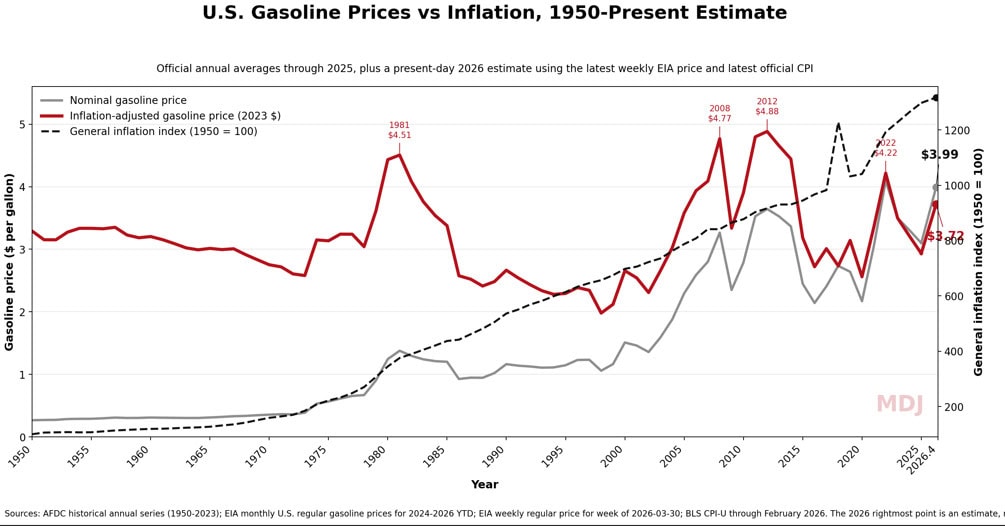
In the above graph we can see a few things pretty quick:
- In inflation-adjusted terms, we’re still pretty far away from the gas price shocks of 1981, 2008, and 2012, and even 2022.
- General inflation went up WAY faster than the price of gas from 1980 to 2005, and then again from 2015 to today.
- If we compare the inflation rate of big ticket items like houses or a university education, gas is WAY cheaper relative to those items.
Just some food for thought as we contextualize how high fuel costs in Canada actually are thanks to this Straight of Hormuz party we’re having.
Gas Prices Aren’t the Real Killer
Obviously gas prices matter. I’m not pretending otherwise.
If regular gas jumps 30 or 40 cents per litre in a short period of time, that hurts. It hurts even more if you commute a long distance, drive a larger vehicle, or spend half your life running kids and groceries and hockey equipment from one end of the city to the other (or hundreds of kms between small towns where I grew up).
From a long-term personal finance perspective though, it bears diving in a bit to understand how small a factor it is in your overall vehicle ownership budget. A recent Canadian vehicle-cost study broke total vehicle costs into all the stuff drivers actually pay for: depreciation, financing interest, sales tax, insurance, fuel, maintenance, repairs, tires, registration, and miscellaneous costs.
Fuel costs only accounted for about 20% of total vehicle operating cost, while ownership costs alone – depreciation, interest, and acquisition sales tax – accounted for 44.3%. Insurance was another 15.3%.
The average total cost in that study came to about 60.6 cents per kilometre. On a vehicle driven 20,000 km per year, that works out to roughly $12,120 annually. Of that total, fuel was about $2,420. Ownership costs were about $5,360. Insurance added about $1,860. Maintenance, repairs, tires, and related sales tax added roughly another $2,380. In other words, even if gas prices are the most visible cost, they are nowhere close to the majority of vehicle costs.
And that lines up pretty nicely with the bigger household-spending picture. Statistics Canada says transportation accounted for 15.8% of household consumption in 2023, with average household transportation spending at $12,090. Average spending on gasoline and other fuels was $2,567. So once again, fuel was meaningful, but it was only about one-fifth of the overall transportation category.
The Real Cost of Buying an Expensive Vehicle in Canada
Instead of sitting in line for a half hour to save three cents per litre, take some time to really consider the tradeoffs of owning that big/expensive vehicle in the first place. Depreciation and sales taxes are silent killers – they’re not posted on highway signs every day.
I know – it’s nice to drive big vehicles. Who doesn’t want an expensive car to feel cool and confident in? For some folks out there, it’s probably worth it to pay these increased costs – but for most of us… I don’t know if the tradeoffs are worth it.
By the way, I’ve heard the argument that we need bigger vehicles for safety or to drive in bad weather. I know that when I was a young adult, the Honda Civic and Toyota Corolla were the two bestselling Canadian vehicles for over a decade.
I’m pretty sure the roads were just as bad then. While a larger vehicle is obviously slightly safer to be in if you’re in a head-on collision, they actually have higher fatality rates in rollover situations. I think overall, if we’re being honest with ourselves, comfort and status are much larger factors than safety in this decision-making process.
Canadians have been steadily moving toward larger vehicles for years. In 2024, multipurpose vehicles – which is the category that includes most SUVs and crossovers – made up 62.9% of all new vehicle registrations in Canada. Back in 2017, that figure was 42.1%. Passenger cars keep taking up a smaller and smaller share of the market, while pickups and SUVs continue to dominate. So when we talk about transportation costs rising, it is not just because life is more expensive in general. It is also because we keep choosing bigger, pricier vehicles.
In the United States, about two-thirds of new vehicles now fall into the “truck” category under regulatory definitions, which includes pickups and many SUVs. Vehicle size, weight, and horsepower have all generally trended upward. In other words, this is not just a Canadian weakness. Across the continent, we have spent years normalizing bigger and heavier vehicles, and then we act surprised when transportation starts eating an absurd percentage of the household budget.
The financing side of this story gets increasingly important as we decide to take bigger and bigger loans, for bigger and bigger cards. One of the main reasons people convince themselves they can afford a more expensive vehicle is that lenders and dealers stretch the loan out longer and longer. In mid-2024, the average Canadian car loan was 71 months. That’s up from 48 months 20 years ago. Interesting to note that 1-in-10 car loans are now 96-month in duration!
Recent Canadian pricing data showed the average new vehicle around $58,000, the average SUV around $57,000, the average minivan around $69,000, and the average truck over $82,000. So even if the average crossover is not dramatically more expensive than the average car, the moment you step into trucks and larger family vehicles, the math gets ugly fast. At typical current borrowing rates, financing an $82,000 truck over seven years can mean roughly $20,000 in interest alone.
If we look at the cost of an average new vehicle vs buying a used one (currently about $35,000 according to AutoTrader), you’re looking at close to $4,000 difference just in HST before you drive it off the lot. If you were to drive each vehicle for seven years before moving on, you’re probably looking at close to $40,000 in depreciation on that new ride, versus about $15,000 on the used one. We haven’t even gotten into the higher insurance costs, repair bills, etc. These massive differences are going to hit your chequing account way harder than fuel price spikes!
Canadian gas prices may be the loudest part of the transportation conversation at the moment, but buying too much vehicle is often the decision that does the real long-term damage.









If you’re going to talk about the finances of car ownership, you should really consider the EV option and look at it through the lens of total cost of ownership (TCO) over a given period, say 5 years.
One semi-financial aspect of EV ownership that I haven’t seen discussed much is the huge benefit of EVs requiring much less maintenance: not only are you saving on the actual cost of maintenance & repairs, but you’re saving all the time, energy and stress of bringing a car to a garage for unknown lengths of time, for unknown outcomes, at an unknown price, with often unreliable mechanics.
We drove right around 50,000km last year. Our cost breakdown on vehicles was $6,514 fuel, $2,178 R&M, $3,673 insurance. They are older vehicles, so my best guess is around $3k in depreciation as well. I would love an EV, but living rural, I’ll make do with my high mileage Odyssey and Tiguan for now.
I own a “mid-size” crossover SUV. I wish there were a reliable EV in this class that could tow my kayak trailer round trip for 500kms. We’re not there yet. I did my best to find as fuel efficient a model as I could. I’m really taking it easy on the gas pedal of late, getting 7.5L / 100km. That’s better than the 7.9L / 100km it’s rated for on highway driving. I’ll take it. I bought it used and had to self finance. A good driving record helps keep the insurance costs down.
I look forward to improved EV performance in this category and hopefully my next vehicle will be all electric.
I so relate to this. The oil crisis in the 1970s should have been enough of a wake up call for consumers, but few learn from history.. I heard so many of my office dwelling co-workers financing $100k+ F-150 purchases over the last 5 years.. I feel zero sympathy. Over the last 5 years of EV ownership I’ve saved ~$3k/yr on gas alone and this year it’ll be $4k. As a consumer, willingly being beholden to global oil markets when you no longer have to is just so short sighted.